Quick Answer
Spanish baby names reflect a rich mix of linguistic, historical, and cultural traditions. Names such as Sofía, Lucía, Mateo, and Alejandro are used in Spanish speaking communities, although their origins may lie in Greek, Latin, Hebrew, or other languages. Spanish naming traditions also include Catholic and Marian names, regional influences, and compound names. Exploring meanings, origins, and usage can help parents choose a name that fits their family and heritage.
Spanish baby names reflect much more than the Spanish language itself. Names used in Spain and across Spanish speaking countries come from Latin, Greek, Hebrew, Germanic, Basque, Arabic, and other linguistic traditions, while centuries of Christianity, regional identity, family customs, and local languages have shaped how those names are used.
That means a name can be Spanish in usage without being Spanish in origin. For example, Sofía comes from Greek, Mateo is the Spanish form of Matthew, and Javier developed through a Basque place name tradition. At the same time, names such as Carmen, Pilar, Dolores, and Rocío have strong connections to Spanish Catholic and Marian traditions.
For parents searching for Spanish baby names, the most useful approach is to consider meaning, language of origin, actual Spanish usage, gender, regional context, and religious associations separately.The list below brings these details together, helping you compare names while distinguishing their cultural associations from their linguistic origins.
Spanish Baby Names at a Glance
Spanish naming traditions are not identical across every Spanish speaking country. A name common in Spain may have a different level of recognition in Mexico, Argentina, Colombia, Puerto Rico, or another Spanish speaking community. Regional languages within Spain also matter: Catalan, Basque, Galician, and other traditions contribute names that may coexist with Spanish forms.
For that reason, the names below are best understood as names with established Spanish usage, with Spain specific notes included where reliable data is available.
Girl Names Widely Used Across Spain
| Name | Gender | Meaning | Origin / Language | Cultural or Religious Context |
|---|---|---|---|---|
| Sofía | Girl | Wisdom | Greek; Spanish and Galician form of Sophia | Widely used in Spain and Spanish speaking countries; Christian use exists, but the name is Greek rather than specifically Spanish or biblical |
| Lucía | Girl | Light | Latin, from lux | Spanish form of Lucia; also associated with Saint Lucy, giving it a Christian historical connection |
| Isabel | Girl | Ultimately related to “my God is an oath” | Hebrew through medieval Occitan | Long established Spanish form of Elizabeth; historically associated with Spanish royalty |
| Inés | Girl | Traditionally interpreted as pure or chaste | Greek, through Agnes | Spanish form of Agnes; associated historically with Saint Agnes |
| Alba | Girl | Dawn | Latin/Spanish lexical tradition | Alba means “dawn” in Spanish; it is not inherently a religious name |
| Paloma | Girl | Dove | Spanish | A Spanish word name; the dove also carries Christian symbolism, but the name itself is not exclusively Christian |
Traditional Names Linked to Marian and Catholic Devotion
| Name | Gender | Meaning | Origin / Language | Cultural or Religious Context |
|---|---|---|---|---|
| Carmen | Girl | Traditionally connected with Mount Carmel | Hebrew place name tradition; Spanish devotional usage | Strongly associated with María del Carmen and Our Lady of Mount Carmel |
| Pilar | Girl | Pillar | Spanish | Comes from María del Pilar, a Marian title associated with Our Lady of the Pillar |
| Dolores | Girl | Sorrows | Spanish from Latin dolor | From Nuestra Señora de los Dolores, Our Lady of Sorrows |
| Belén | Girl | House of bread | Hebrew place name, via Bethlehem | Spanish form of Bethlehem; strongly associated with the Nativity because Bethlehem is the biblical birthplace of Jesus |
| Mercedes | Girl | Mercies | Spanish from Latin merces | Derived from Nuestra Señora de las Mercedes, Our Lady of Mercies; a Marian devotional name |
| Rocío | Girl | Dew | Spanish | From María del Rocío, a Marian title; pronunciation differs between European and many Latin American varieties |
| Concepción | Girl | Conception | Spanish from Latin | Traditionally connected with the Immaculate Conception of the Virgin Mary |
Compound Names Featuring María
| Name | Gender | Meaning | Origin / Language | Cultural or Religious Context |
|---|---|---|---|---|
| María | Girl | Traditionally associated with Mary; etymology is disputed | Hebrew/Aramaic tradition through Greek and Latin forms | One of the most important Christian female names in Spanish naming culture; also appears extensively in compound names |
| María Carmen | Girl | Combination of María + Carmen | Spanish compound name | Historically important in Spain; María Carmen was especially prominent among earlier generations |
Note: María Carmen and related compound forms should not automatically be treated as separate etymological names. They represent Spanish compound naming traditions in which religiously significant names were combined.
Spanish Boy Names
Popular Spanish Boy Names:
| Name | Gender | Meaning | Origin / Language | Cultural or Religious Context |
|---|---|---|---|---|
| Mateo | Boy | “Gift of Yahweh” / “gift of God” | Hebrew origin through biblical Greek and Latin; Spanish form of Matthew | Biblical name associated with Matthew the apostle and Gospel tradition |
| Hugo | Boy | Mind, intellect, spirit | Germanic | Established Spanish usage; not specifically Spanish in origin |
| Martín | Boy | Related to Mars | Latin | Spanish form of Martin; strongly established in Christian Europe through Saint Martin of Tours |
| Alejandro | Boy | Defender of the people | Greek | Spanish form of Alexander; widely used in Spain and the Spanish speaking world |
| Rafael | Boy | “God has healed” | Hebrew | Biblical name associated with the archangel Raphael; also long established in Spanish usage |
| Nicolás | Boy | Victory of the people | Greek | Spanish form of Nicholas; associated with Saint Nicholas |
| Tomás | Boy | Twin | Aramaic, through Greek | Spanish form of Thomas; biblical and Christian historical association |
| Juan | Boy | “Yahweh is gracious” | Hebrew through Greek and Latin | Spanish form of John; one of the most established biblical names in Spanish tradition |
| Manuel | Boy | “God is with us” | Hebrew through Greek and Spanish | Spanish form of Emmanuel; historically important in Christian naming traditions |
Spanish Boy Names with Catholic and Historical Connections
| Name | Gender | Meaning | Origin / Language | Cultural or Religious Context |
|---|---|---|---|---|
| Santiago | Boy | Saint James | Spanish compound form of Santo Iago | Major Spanish Christian name; Saint James is traditionally regarded as Spain’s patron saint |
| Javier | Boy | From a Basque place name, associated with “new house” | Basque, through Xavier | Strongly associated with Saint Francis Xavier and Spanish Catholic tradition |
| Ignacio | Boy | Etymology uncertain | Latin/Roman name tradition | Spanish form of Ignatius; strongly associated with Saint Ignatius of Loyola |
Spanish Boy Names with Germanic and Medieval Roots
| Name | Gender | Meaning | Origin / Language | Cultural or Religious Context |
|---|---|---|---|---|
| Álvaro | Boy | Etymology uncertain; possibly “all” + “aware/cautious” or “guard” | Visigothic/Germanic through Latinized Alvarus | Long established Spanish name; the precise Germanic reconstruction is disputed |
| Fernando | Boy | Traditionally associated with peace + daring/courage | Germanic | Spanish form of Ferdinand; historically prominent among Iberian royalty |
| Gonzalo | Boy | Etymology uncertain; medieval Germanic elements | Germanic, through medieval Gundisalvus | Strong Spanish historical usage; also associated with Saint Gonzalo of Galicia |
| Rodrigo | Boy | Traditionally interpreted from Germanic elements connected with fame and power | Gothic/Germanic through Latinized Rudericus | Important medieval Spanish name, especially through Rodrigo Díaz de Vivar, El Cid |
Which Spanish Baby Names Are Popular in Spain?
If your search specifically means names currently popular for babies in Spain, government data gives a more precise answer than general baby name websites.
Spain’s Instituto Nacional de Estadística (INE) reported that among babies born in 2024, the most frequent first name for girls was Sofía, with 3,325 registrations, while Mateo was the most frequent first name for boys, with 3,289 registrations. Lucía and Martina were also among the leading girls’ names, while Hugo and Martín were among the leading boys’ names.
The same INE data also shows why “Spanish baby names” should not be treated as a single uniform list. The leading names differed by autonomous community. For example, regional results included names such as Laia and Oihan in the Basque Country, Martí in Catalonia, and Manuel in parts of Spain where other national leaders were different.
So if you want a name that reflects current naming patterns in Spain, Sofía, Mateo, Lucía, Martina, Hugo, and Martín are stronger evidence based choices than simply selecting names from an international “Spanish names” list.
Spanish Names Are Not Always Spanish in Origin
One of the easiest mistakes when researching Spanish baby names is assuming that every name used in Spanish must have originated in Spain.
That is not how naming traditions develop.
Greek Origins in Spanish Names
Sofía, Alejandro, Nicolás, and Inés all demonstrate the long history of Greek origin names in Spanish.
- Sofía comes from Greek sophia, “wisdom.”
- Alejandro is the Spanish form of Alexander, from Greek elements associated with defending or helping people.
- Nicolás comes from Greek elements meaning “victory” and “people.”
- Inés is the Spanish form of Agnes, ultimately from Greek hagnos, traditionally associated with purity or chastity.
Their established Spanish usage makes them appropriate for a Spanish name list even though their linguistic origins are older than the Spanish language itself.
Hebrew and Biblical Origins
Spanish naming traditions have also preserved many names of Hebrew origin through Christianity.
Mateo, Juan, Rafael, María, Isabel, Belén, and Tomás illustrate different paths through which biblical and Christian names entered Spanish usage.
This does not mean every one of these names should simply be labelled a “Spanish biblical name.” Their classifications are more precise:
- Mateo is a Spanish form of Matthew, a biblical figure.
- Juan is the Spanish form of John, a biblical name.
- Rafael is the Spanish form of Raphael, an angelic figure in the biblical tradition.
- Belén is a Spanish personal name derived from Bethlehem, a biblical place.
- María is directly connected with Mary, the mother of Jesus in the New Testament.
- Isabel is the Spanish form of Elizabeth, although the Spanish form developed historically through other European languages.
That distinction matters because Spanish usage, biblical origin, and Christian religious significance are three related but different classifications.
Spanish Catholic and Marian Names
Christianity, especially Catholic tradition, has had a major historical influence on naming in Spain. Some names are particularly interesting because they began not simply as ordinary personal names but as references to Marian titles, devotional places, or religious concepts.
Carmen
Carmen is closely associated with María del Carmen, a Spanish title of the Virgin Mary connected with Our Lady of Mount Carmel.
The name therefore has a strong religious cultural association in Spanish naming history. It should not simply be described as the Spanish word for “song”; that popular explanation can confuse the Latin word carmen with the separate Carmel tradition.
Pilar
Pilar literally means “pillar” in Spanish. As a personal name, however, it is especially connected with María del Pilar, Our Lady of the Pillar.
This makes Pilar a particularly clear example of a name whose everyday Spanish meaning and religious naming history both matter.
Dolores
Dolores means “sorrows” and comes from the Marian title Nuestra Señora de los Dolores, or Our Lady of Sorrows.
Its religious association is therefore much more important to its historical use as a personal name than the literal dictionary meaning alone might suggest.
Rocío
Rocío means “dew” in Spanish and is associated with María del Rocío, a Marian title.
The name also illustrates pronunciation differences across Spanish speaking regions: the “c” in European Spanish pronunciation differs from the pronunciation commonly heard in much of Latin America.
Mercedes
Mercedes means “mercies” and comes from the title Nuestra Señora de las Mercedes, Our Lady of Mercies.
It is therefore a Spanish devotional name with a clear religious history rather than merely a Spanish vocabulary word chosen as a name.
Spanish Names Connected With Biblical Places
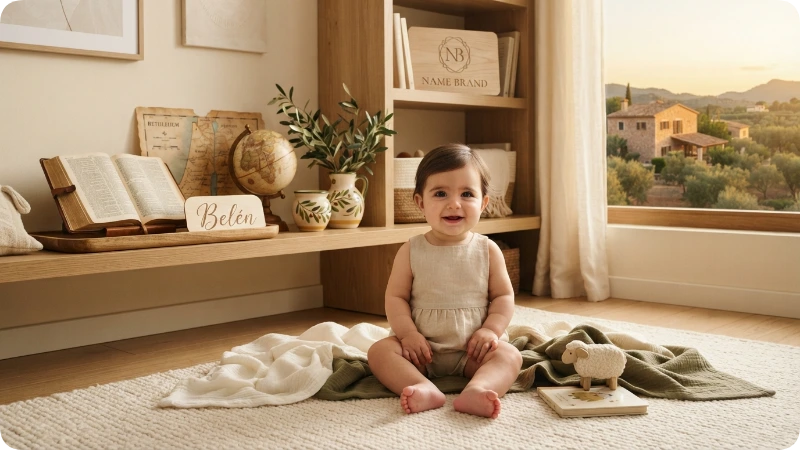
Not every religiously connected Spanish name refers to a person.
Belén is a good example. It is the Spanish form of Bethlehem, the biblical town associated with the birth of Jesus. The Hebrew place name is traditionally understood as “house of bread.”
Because Belén is derived from a place name rather than directly from the name of a biblical person, it is more accurate to call it a biblical place name used as a Spanish personal name.
That distinction prevents the common mistake of placing every religiously familiar name into the same “biblical names” category.
Names With Strong Spanish Historical Identity
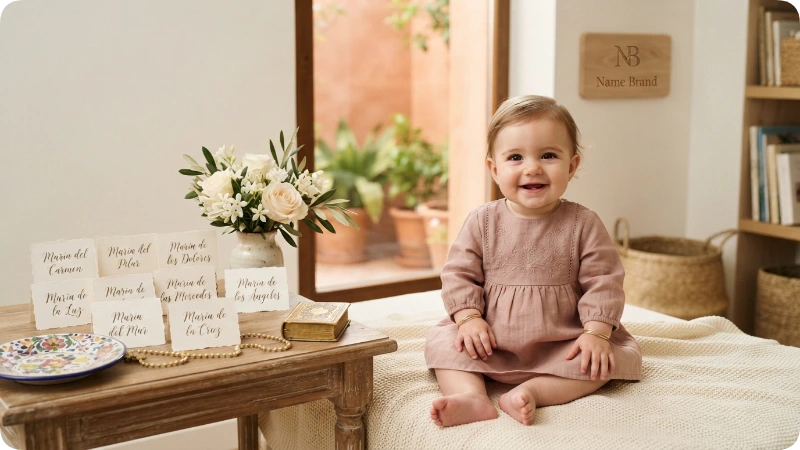
Some names became deeply established in Spanish history even though their linguistic roots are older or come from outside the Iberian Peninsula.
Álvaro
Álvaro is a Spanish form of the Latinized Alvarus, derived from a Visigothic/Germanic naming tradition. Its exact original elements are debated, with proposed interpretations involving ideas such as being watchful or guarding.
It is therefore better to describe Álvaro as a traditional Spanish name of Germanic/Visigothic origin than simply calling it a Spanish origin name.
Rodrigo
Rodrigo comes through the Latinized Gothic form Rudericus. Its Spanish historical identity is especially strong because of Rodrigo Díaz de Vivar, better known as El Cid.
The name is consequently a useful choice for parents interested in medieval Spanish history rather than only religious naming.
Javier
Javier has a different story. It developed from the Basque place name associated with Xavier, and its later popularity was strongly reinforced by Saint Francis Xavier.
This is a good example of why regional language and religious history can overlap: the linguistic background is Basque, while the later Spanish cultural association is strongly Catholic.
Spanish Compound Names and Marian Traditions
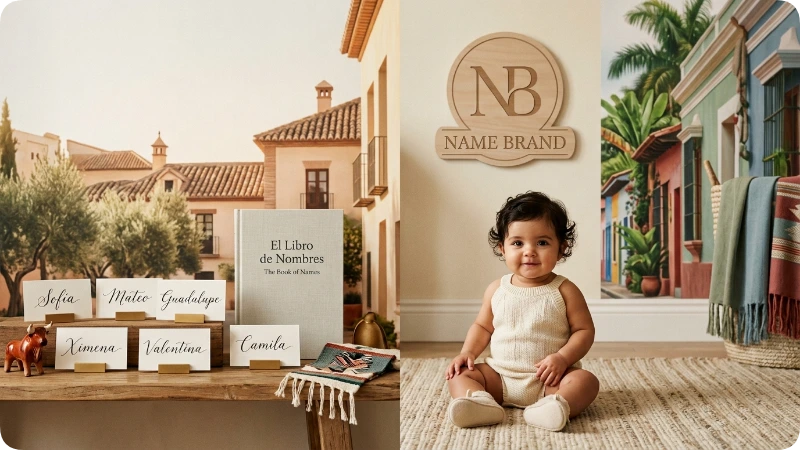
Traditional Spanish naming cannot always be understood by looking only at single names.
Compound names have played an important role, particularly combinations involving María and a Marian title or devotional reference.
Examples include:
- María del Carmen: Mary of Mount Carmel
- María del Pilar: Mary of the Pillar
- María de los Dolores: Mary of Sorrows
- María de la Luz: Mary of the Light
- María de las Mercedes: Mary of Mercies
- María de los Ángeles: Mary of the Angels
- María del Mar: Mary of the Sea
- María de la Cruz: Mary of the Cross
Historically, women with compound names could commonly be known in everyday life by the second element. For example, someone formally named María del Carmen might be called Carmen in ordinary conversation.
This tradition is one reason a list of Spanish names can look very different from a simple list of modern English style first names.
Spain Is Not the Same as the Entire Spanish Speaking World
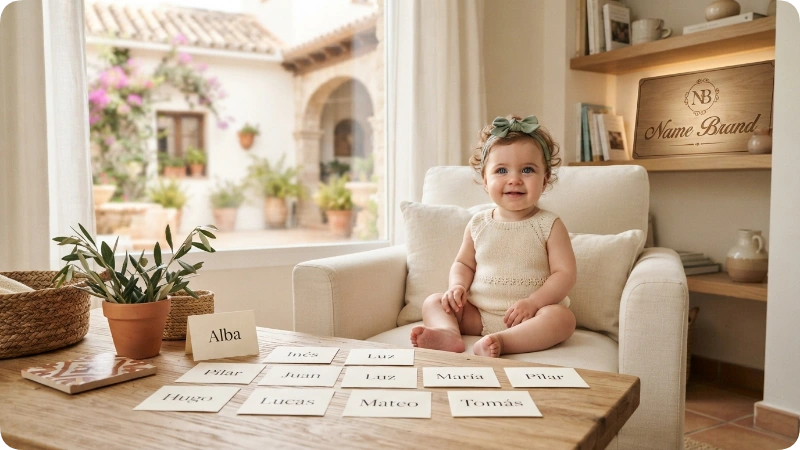
The phrase “Spanish baby names” can refer to two different searches.
Spanish Names Used in Spain
If you mean names associated specifically with Spain, regional languages and Spanish national statistics are especially important.
For example, Spain’s 2024 newborn data included regional leaders such as:
- Laia in Catalonia related naming patterns
- Oihan in the Basque Country
- Martí in Catalonia
- Manuel in Extremadura
- María in Andalusia
- Adam in the Canary Islands
These examples demonstrate that Spain itself has several naming traditions rather than one completely uniform naming pool.
Spanish Language Names Across the Americas
A name may be very common in Mexico, Argentina, Colombia, Puerto Rico, or another Spanish speaking country without being especially characteristic of contemporary Spain.
For example, Guadalupe has an especially strong Mexican cultural history, while Ximena, Valentina, Camila, and many other names have different levels of use across Spanish speaking countries.
For a child whose family heritage is specifically from one country, country level research is therefore more useful than relying on a generic “Spanish” label.
Short Spanish Baby Names
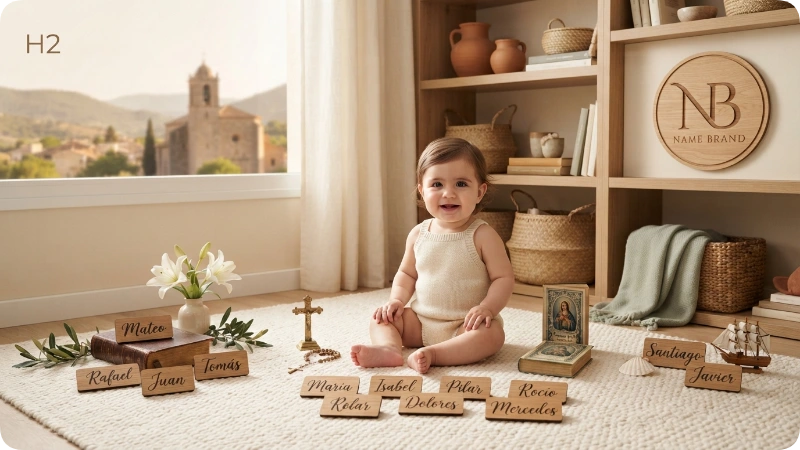
Parents looking for shorter names can consider:
Girls
- Alba
- Inés
- Luz
- María
- Pilar
Boys
- Juan
- Hugo
- Lucas
- Mateo
- Tomás
Short does not automatically mean Spanish origin. For example, Lucas is a Greek/Latin historical name used widely in Spanish, while Hugo is Germanic in origin.
Spanish Baby Names With Strong Religious Connections
If religious meaning is important, it helps to separate the names by the type of connection they have.
Biblical or Scriptural Names
- Mateo: biblical apostle and Gospel name
- Juan: biblical John
- Tomás: biblical Thomas
- Rafael: biblical/angelic name
- María: New Testament figure
- Isabel: Spanish form of Elizabeth
Marian Devotional Names
- Carmen
- Pilar
- Dolores
- Rocío
- Mercedes
- Concepción
- María del Carmen
- María del Pilar
These are not all “biblical names.” Several developed from later Christian devotion and Marian titles.
Christian Historical Names
- Javier: associated with Saint Francis Xavier
- Ignacio: associated with Saint Ignatius of Loyola
- Martín: associated with Saint Martin of Tours
- Santiago: Saint James and an important Spanish pilgrimage tradition
This classification gives a more accurate picture of Spanish Christian naming than simply putting every religiously familiar name under “biblical.”
Spanish Biblical Baby Names
Spanish biblical baby names combine Spanish language forms with names from the Bible. These options are suitable for parents looking for a name with both Spanish usage and biblical significance.
Spanish Girl Names
- María: Spanish form of Mary, the mother of Jesus in the New Testament.
- Isabel: Spanish form of Elizabeth, the mother of John the Baptist in the New Testament tradition.
- Eva: Spanish form of Eve, the first woman in the biblical creation account.
- Rebeca: Spanish form of Rebecca, the wife of Isaac in the Old Testament.
- Sara: Spanish form of Sarah, the wife of Abraham in the Old Testament.
Spanish Boy Names
- Mateo: Spanish form of Matthew, one of Jesus’ apostles and the traditional name associated with a Gospel.
- Juan: Spanish form of John, a name shared by several figures in the New Testament.
- José: Spanish form of Joseph, the name of Mary’s husband in the New Testament.
- David: The biblical name of the king of Israel.
- Gabriel: The name of an angel who appears in biblical traditions.
How to Choose the Right Spanish Baby Name
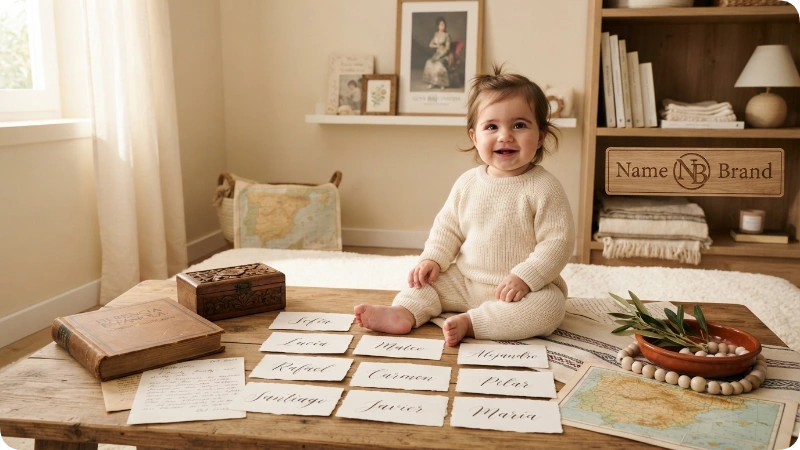
Start with the family connection you actually want the name to express.
For Spanish heritage from Spain, consider established Spanish names alongside regional traditions from Catalonia, the Basque Country, Galicia, and other parts of the country.
Those interested in Catholic heritage may prefer names such as Carmen, Pilar, Dolores, Mercedes, Santiago, Ignacio, and María, which have strong historical religious connections.
For biblical heritage in a Spanish form, Mateo, Juan, Rafael, Tomás, María, and Isabel are clear choices.
Meanwhile, parents seeking a Spanish language name that works internationally might consider Sofía, Lucía, Mateo, Alejandro, and Rafael for their established Spanish usage and recognition beyond Spain.
Also check the pronunciation you expect your family to use. Spanish pronunciation can change noticeably between Spain and Latin America, particularly with sounds such as c, z, and j.
FAQs
Popular and Traditional Spanish Baby Names
What are the most popular Spanish baby names in Spain?
For babies born in Spain in 2024, Sofía was the most frequent girl name and Mateo was the most frequent boy name according to Spain’s INE. Lucía, Martina, Hugo, and Martín were also among the leading names.
What is a truly Spanish origin baby name?
There is no single requirement for a name to qualify as “Spanish.” Some names have developed as Spanish forms of older Hebrew, Greek, Latin, or Germanic names, while others have Spanish lexical or regional origins. Javier, for example, has a Basque place name background, while Sofía is Greek in origin but established in Spanish usage.
Are Spanish baby names always Catholic?
No. Spain has a long Catholic naming history, but modern Spanish naming is much broader. Many names are used for cultural, family, linguistic, historical, or personal reasons without implying a religious identity.
What are traditional Spanish girl names?
Traditional examples include María, Carmen, Isabel, Pilar, Dolores, Inés, Mercedes, and Rocío. Some have especially strong Catholic or Marian histories, while others have broader European origins and long standing Spanish usage.
What are traditional Spanish boy names?
Examples include Juan, José, Manuel, Fernando, Javier, Santiago, Rafael, Ignacio, Martín, and Rodrigo. Their histories vary considerably, from biblical names to saint names and medieval Iberian traditions.
Spanish Names and Their Origins
Is Mateo a Spanish name or a biblical name?
It is both, but in different senses. Mateo is the Spanish form of Matthew, so its linguistic classification is Spanish usage, while its underlying name and religious association are biblical.
Are Hispanic and Spanish baby names the same?
No. Spanish can refer specifically to Spain or to names used in the Spanish language, while Hispanic is a broader cultural and linguistic category. A name can be common in Latin America without being particularly characteristic of Spain, and vice versa.
Final Thoughts
The strongest Spanish baby names are not necessarily the names that simply appear on a generic “Spanish names” list.
A better choice comes from understanding where a name comes from, how Spanish speakers actually use it, what region it belongs to, and if its religious connection is biblical, saintly, Marian, or simply cultural.

Brian Cox is a names editor and naming researcher at NameBrande.com who believes choosing a name starts with understanding its meaning, sound, and character. He focuses on boy names, naming styles, origins, and practical name ideas, turning research into clear, useful guides.
Areas of Focus: Boy Names | Name Meanings | Name Origins | Naming Styles | Name Ideas | Naming Research