Quick Answer
Irish baby boy names include traditional Gaelic names, legendary heroes, and names connected with Ireland’s Christian heritage. Oisín means “little deer,” Tadhg means “poet,” and Aodhán means “little fire.” if you prefer an ancient Irish name or a familiar modern choice, understanding its meaning, pronunciation, and cultural roots can help you find the right name for your baby boy.
Choosing an Irish baby boy name is about more than finding a name that sounds Irish. Some names come from Old Irish and traditional mythology, while others reflect Christian history or languages that became part of Irish naming traditions. Understanding their meanings and origins can help you choose a name with a genuine cultural connection.
This guide to Irish baby boy names explores their meanings, linguistic origins, pronunciations, historical backgrounds, and cultural significance. Names such as Oisín, Fionn, Cian, Dáire, and Tadhg are closely connected to the Irish language and literary tradition, while Seán, Eoin, and Pádraig are Irish language forms of names with origins beyond Ireland.
Rather than treating every name labeled Irish as having the same background, this guide distinguishes established meanings from uncertain etymologies and explores connections to mythology, saints, historical figures, and modern naming trends. It also examines official 2025 baby name statistics from Ireland to provide context on contemporary usage.
Irish Baby Boy Names: A PracticIrish Boy Names: A–Z Starting List
Here is a focused selection of established Irish masculine names, with related spellings consolidated rather than counted as separate names.
Traditional Irish Names and Their Meanings
| Name | Meaning / Etymology | Irish Context | Religious or Historical Link |
|---|---|---|---|
| Rían / Rian | Meaning uncertain; traditionally interpreted as “little king” | Irish name; related to Ryan | Modern Irish usage |
| Oisín | Little deer | Old Irish; Irish mythology | Son of Fionn; warrior poet |
| Fionn | White, fair; traditional interpretations vary | Old Irish; Irish mythology | Fionn mac Cumhaill |
| Cian | Ancient, enduring | Old Irish; Irish mythology | Legendary Irish figures |
| Conall | Etymology uncertain; traditionally associated with “rule” and “wolf” | Old Irish | Irish legend and Ulster Cycle |
| Dáire | Fruitful, fertile | Irish; Irish mythology | Several figures in Irish legend |
| Tadhg | Poet | Old Irish | Medieval kings and Irish mythology |
| Cormac | Etymology uncertain | Old Irish | High king tradition and Irish saints |
| Aodhán | Little fire | Old Irish | Early Irish kings and saints |
| Ciarán | Diminutive of Ciar; traditionally associated with “dark” | Old Irish | Two prominent 6th century Irish saints |
| Cillian | Probably related to ceall, “church” | Irish | 7th century Saint Cillian |
| Fiachra | Etymology uncertain; possibly associated with “raven” | Old Irish | Irish legend and Saint Fiacre |
| Rónán | Little seal | Old Irish | Several early Irish saints |
| Eoghan | Possibly “born of the yew”; etymology disputed | Old Irish / Irish | Irish legendary and historical figures |
| Naoise | Meaning uncertain | Irish; Irish mythology | Hero in the story of Deirdre |
| Cathal | Battle + rule | Old Irish | Irish kings and Saint Cathal |
| Pádraig | Irish form of Patrick | Irish form of a Latin origin name | Saint Patrick |
| Colm | Irish form of Columba | Irish | Strong early Christian association |
| Conor | Irish/anglicized form associated with Conchobar/Conchúr | Irish | Ulster Cycle tradition |
| Ruairí | Form of Ruaidhrí; traditionally associated with “red” + “king” | Irish | Medieval Irish kings |
| Declan | Meaning uncertain; possibly related to dag, “good” | Irish form of Deaglán | 5th century Saint Declan |
| Seán | Irish form of John | Irish form of a biblical name | John in Christian and biblical tradition |
| Eoin | Irish form of Iohannes/John | Irish | Biblical and Christian connection |
Understanding Irish Origins and Cultural Connections
The list includes both native Irish names and Irish forms of names from other linguistic traditions. Although these names are established in Irish naming culture, they do not all share the same linguistic origin. Distinguishing their etymology from their historical, religious, and cultural associations helps parents understand each name more accurately.
Names Deeply Connected to Irish Mythology
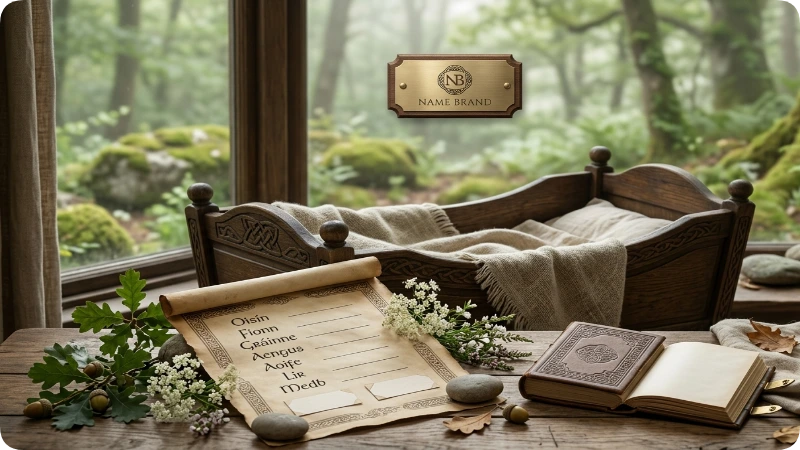
Irish mythology is one of the clearest sources for boys’ names that are culturally Irish rather than simply names used in Ireland.
Oisín “Little Deer”
Oisín comes from Old Irish oss, “deer” or “stag,” combined with a diminutive element, giving the established meaning “little deer.” In Irish legend, Oisín is the son of Fionn mac Cumhaill and a warrior and poet whose voice appears throughout the Fenian tradition.
The Irish pronunciation is approximately uh SHEEN, while English speakers often use a similar oh SHEEN pronunciation. The fada over the í is part of the modern Irish spelling.
Gender: Masculine in established Irish usage.
Fionn “White, Blessed”
Fionn comes from the Old Irish name Finn, derived from finn, meaning “white” or “blessed.” The most famous bearer is Fionn mac Cumhaill, the central hero of the Fenian Cycle of Irish mythology.
Fionn and Oisín therefore belong to the same important mythological naming tradition, but they are separate names and should not be treated as variants.
Cian “Ancient, Enduring”
Cian means “ancient” or “enduring” in Irish. In Irish mythology, Cian is associated with Lugh Lámfada and other legendary figures. The name has also remained in Irish usage beyond mythology.
Pronunciation: Approximately KEE an in Irish.
Conall — “Rule of a Wolf”
The Irish name Conall is traditionally interpreted as “rule of a wolf.” Its roots are associated with the Old Irish elements cú, meaning “hound” or “wolf,” and fal, meaning “rule.” In Irish mythology, Conall Cernach is a prominent warrior and one of the major figures in the Ulster Cycle.
This is a good example of a name whose modern meaning is best explained through its historical linguistic elements rather than through symbolic personality claims.
Dáire “Fruitful, Fertile”
Dáire is an Irish name meaning “fruitful” or “fertile.” It occurs in several Irish legendary traditions, including the story of Dáire mac Fiachna and the Brown Bull of Cooley.
The anglicized forms Dara, Daragh, and Darragh are related forms, but they should not automatically be counted as separate Irish names. Darragh, for example, is an anglicized form of Dáire or Darach.
Tadhg “Poet”
Tadhg comes from Old Irish Tadg, meaning “poet.” The name was borne by medieval kings and chieftains and also occurs in Irish mythology.
Common related spellings include Tadgh, Teague, Teige, and Teigue. These are forms or anglicizations of the same naming tradition rather than entirely separate names.
Irish Names With a Strong Christian and Saint Tradition
Irish naming history is not exclusively Christian. Some names come from pre Christian Irish language and mythology, while others became strongly associated with Christianity through Irish saints.
That distinction is worth preserving: a name can be Irish and Christian associated without being originally Christian.
Ciarán An Early Irish Saint Name
Ciarán is a diminutive of Ciar, an Old Irish name associated with ciar, “black” or “dark.” The name was borne by two important sixth century Irish saints: Ciarán the Elder, associated with Saighir, and Ciarán the Younger, associated with Clonmacnoise.
Ciarán therefore has both an Irish linguistic history and a significant Christian history in Ireland.
The anglicized form Kieran is widely recognized outside Ireland, but Ciarán preserves the Irish spelling.
Cillian Probably Related to “Church”
Cillian is probably derived from Old Irish cell, “church,” with a diminutive suffix. The name was borne by a seventh century Irish saint who evangelized in Franconia and was martyred at Würzburg.
This gives Cillian a particularly clear Irish and Christian combination, although its etymological explanation should remain qualified because the source describes the “church” derivation as probable rather than absolutely certain.
Fiachra Irish Legend and Saint Tradition
Fiachra comes from Old Irish Fiachrae. Its etymology is uncertain, with possibilities involving fiach, “raven,” or a combination associated with battle and kingship.
The name appears in Irish mythology through one of the children of Lir and also has an important Christian association through Saint Fiacre, a seventh century Irish abbot who became associated with gardening in France.
Rónán “Little Seal”
Rónán comes from Old Irish rón, meaning “seal,” combined with a diminutive suffix. Several early Irish saints bore the name, including a sixth century figure associated with Locronan in Brittany.
The anglicized Ronan is commonly used internationally, while Rónán retains the Irish spelling.
Aodhán “Little Fire”
Aodhán comes from Old Irish Áedán, a diminutive of Áed/Aodh, meaning “fire.” The resulting meaning is “little fire.” The name was borne by a sixth century king of Dál Riata and by several early Irish saints.
The familiar English form is Aidan. The two should not be counted as separate names simply because the spelling differs.
Irish Forms of Biblical and Christian Names
Some Irish baby boy names are especially interesting because they look completely different from their English equivalents while belonging to the same broader naming family.
Seán Irish Form of John
Seán is the Irish form of John, transmitted through the Old French Jehan. The underlying name ultimately comes from the Hebrew name represented in English as John.
This means Seán is genuinely an Irish name in language and usage, but not originally an Irish language creation.
The spelling Sean, without the fada, is common internationally. Ireland’s Central Statistics Office has treated Seán and Sean as separate spellings in its baby name statistics since the introduction of diacritics into the dataset in 2018. In 2025, Seán ranked 23rd in the Republic of Ireland, while Sean ranked 141st.
Eoin Another Irish Form of John
Eoin is the Irish form of Iohannes, the Latin form of John. The underlying biblical name is therefore not Irish in origin, but Eoin is firmly established as the Irish language form.
Its Irish pronunciation is approximately OH in.
This makes Eoin useful for families who want a name with the Christian and biblical history of John while retaining an Irish language form.
Pádraig Irish Form of Patrick
Pádraig is the Irish form of Patrick, from the Latin Patricius. It is therefore better described as an Irish language form of a Latin origin Christian name rather than a name whose original etymology is Irish.
Its connection with Ireland is especially strong because of Saint Patrick, whose name became central to Irish Christian tradition.
Related forms include Pádraic and Páidí, while Patrick is the English form.
Colm Irish Form of Columba
Colm is an Irish form of Columba. The Old Irish element colum also means “dove,” while Columba itself is a Latin name derived from columba, “dove.”
Colm therefore illustrates another important distinction: the name has an Irish form and a strong Irish Christian history, but its linguistic roots ultimately extend into Latin.
Traditional Irish Names With Uncertain Meanings
Not every old Irish name has a secure modern translation. A good baby name article should say so instead of inventing a simple English meaning.
Cormac
The etymology of Cormac is uncertain. It comes from Old Irish Cormacc or Corbmac, with proposals involving elements meaning “chariot” or “wagon” and macc, “son.” The exact interpretation remains disputed.
Cormac has a strong historical and legendary presence through Cormac mac Airt, the semi legendary High King of Ireland. The name was also borne by several early saints.
Naoise
Naoise has an unknown meaning and is generally considered to be of Irish origin. Its strongest cultural connection is literary and mythological: Naoise is the young man who elopes with Deirdre in the Ulster Cycle before their tragic fate.
Because the meaning is not securely known, claims that Naoise means a particular English word should be treated cautiously.
Eoghan
The meaning of Eoghan is also debated. One proposal derives it from Old Irish elements associated with being “born from the yew tree,” while another possibility connects it with the Latin name Eugenius.
Eoghan has a long Irish historical and legendary presence and should therefore be considered an established Irish name even though its exact etymology remains uncertain.
Declan
Declan is the anglicized form of Irish Deaglán or Old Irish Declán. Its exact meaning is unknown, although it probably begins with the Old Irish prefix dag, “good.”
Its strongest religious connection comes from Saint Declan, a fifth century missionary associated with the Déisi peoples and the monastery at Ardmore.
The frequently repeated definition “man of prayer” should therefore not be presented as a securely established etymological meaning.
Modern Irish Choices: What 2025 Data Actually Show
For current popularity, the strongest available source is the Central Statistics Office of Ireland (CSO). Its 2025 statistics cover births registered in the Republic of Ireland, not the entire island of Ireland or Irish communities worldwide.
In 2025, the five most popular boys’ names in the Republic of Ireland were:
- Rían
- Jack
- Noah
- James
- Oisín
Rían reached the number one position for the first time in the CSO’s series, while Oisín remained in the national top five.
The CSO recorded 4,848 distinct boys’ names in 2025. Its data also show that Rían was the most popular boys’ name among babies whose parents were both Irish nationals.
This distinction matters because a name being highly ranked in Ireland does not automatically mean it is “popular among Irish people” everywhere. The CSO is reporting births registered in the Republic of Ireland and can further classify names by parental nationality and geographic area.
Rían and the Fada
Rían is especially useful when discussing modern Irish naming because the síneadh fada matters. The CSO has included fadas and other diacritics in its name data since 2018 and treats differently spelled forms such as Seán and Sean as separate entries.
For families choosing an Irish language spelling, it is therefore worth deciding if preserving the fada is important before registering and using the name internationally.
Irish Names by Naming Style
Names Rooted in Irish Mythology
- Fionn: A central figure in the Fenian Cycle of Irish mythology.
- Oisín: The son of Fionn, Oisín is known as both a warrior and a poet.
- Cian: This figure is associated with the Tuatha Dé Danann in Irish mythology.
- Conall: The name is prominently connected with the Ulster Cycle.
- Naoise: Remembered as a central figure in the tragic story of Deirdre.
- Dáire: This name appears in several Irish legends and mythological traditions.
- Tadhg: With historical and mythological uses in Ireland, Tadhg has a longstanding cultural presence.
For Christian and Saint Connections
- Pádraig: The Irish form of Patrick, this name is closely connected with Ireland’s Christian heritage.
- Ciarán: Several prominent early Irish saints bore this name, including Saint Ciarán of Clonmacnoise.
- Cillian: Its Christian associations include Saint Kilian, an Irish missionary who became known for his work on the European continent.
- Rónán: Several early Irish saints carried this traditional name.
- Aodhán: Early Irish Christian history includes religious figures who bore this name.
- Fiachra: This name is associated with Saint Fiacre, an Irish born saint who became known in France.
- Declan: Closely linked to Saint Declan, an early Irish Christian missionary associated with Ardmore.
- Colm: The Irish form of Columba, this name is associated with Saint Columba of Iona.
Names with a Modern Irish Feel
These names have a familiar place in contemporary Irish naming culture while retaining their traditional linguistic or cultural character.
- Rían
- Cian
- Oisín
- Fionn
- Cillian
- Dáire
- Tadhg
- Eoghan
- Conor
- Rónán
This grouping reflects cultural and linguistic character rather than a ranking of which name is “better.”
Irish Spelling, Fadas, and Anglicized Forms
Irish spelling can look unfamiliar to English speaking parents, but the differences are part of the language rather than decorative additions.
A fada is the accent mark used over vowels in Irish, as in:
- Rían
- Oisín
- Ciarán
- Rónán
- Pádraig
- Seán
- Ruairí
Removing the fada can change the written form and, depending on the name, can affect pronunciation or how strongly the name is identified with Irish orthography.
There is also a long history of anglicization. For example:
- Oisín → Osheen
- Aodhán → Aidan
- Ciarán → Kieran
- Rónán → Ronan
- Pádraig → Patrick
- Seán → Sean/Shane
- Tadhg → Teague
- Conchobar/Conchúr → Conor
These forms should not automatically be counted as separate names when they are established linguistic or anglicized counterparts.
How to Choose an Irish Baby Boy Name
The best shortlist usually becomes much smaller once language, pronunciation, and cultural connection are considered.
Decide what “Irish” means to your family
Do you want:
- a name originally formed in Irish?
- an Old Irish historical name?
- a name from Irish mythology?
- an Irish language form of a Christian or biblical name?
- a name currently used in the Republic of Ireland?
- an Irish spelling that will remain recognizable internationally?
Those are different goals.
Check the original form
If you like Conor, for example, know that it is an anglicized form associated with Conchobar or the modern Irish Conchúr. If you prefer the Irish language form, the spelling and pronunciation are different.
Likewise, Pádraig is not simply an Irish translation of a random English name; it is the established Irish form of Patrick.
Decide if you want the fada
A fada can preserve the Irish spelling, but families living outside Ireland may also want to consider how consistently schools, databases, travel documents, websites, and international keyboards handle diacritics.
That is a practical consideration rather than an argument for or against the Irish spelling.
Check pronunciation before committing
Names such as Oisín, Naoise, Tadhg, Ruairí, and Eoin may be unfamiliar to people who have not encountered Irish before.
That does not make them unsuitable. It simply means pronunciation should be part of the decision rather than an afterthought.
Read the cultural story
If a name comes from Irish mythology, read the original story before choosing it. If it comes from a saint, check the historical tradition surrounding that saint.
The result is a name choice based on the actual cultural connection rather than a one line internet meaning.
FAQs
Popularity and Meanings of Irish Boy Names
What are the most popular Irish baby boy names in Ireland right now?
According to the latest available CSO data for 2025, the top five boys’ names in the Republic of Ireland were Rían, Jack, Noah, James, and Oisín. These figures reflect official birth registrations in the Republic of Ireland, not a worldwide ranking of Irish names.
What is the most popular genuinely Irish name in the 2025 data?
Rían ranked first among boys’ names in the Republic of Ireland in 2025, while Oisín placed fifth. The CSO also reported Rían as the most popular boys’ name among births where both parents were Irish nationals.
What Irish boy name means “little deer”?
Oisín means “little deer,” from Old Irish oss, meaning “deer” or “stag,” combined with a diminutive suffix. Irish mythology also remembers Oisín as the son of Fionn mac Cumhaill.
What Irish boy name means “poet”?
Tadhg comes from Old Irish Tadg, meaning “poet.” The name has historical connections with medieval Irish kings and chieftains and also appears in Irish mythology.
Origins, Traditions, and Saint Connections
Is Seán an Irish name or a biblical name?
It is both in different senses. Seán is the Irish form of John, which ultimately derives from a Hebrew name and has strong biblical associations. Its Irish spelling and pronunciation reflect the language’s naming tradition.
Is Aidan the same name as Aodhán?
Aidan is the common English form associated with Aodhán, derived from Old Irish Áedán, meaning “little fire.” Both belong to the same naming tradition, although their spellings and pronunciations differ.
What Irish boy names are connected with saints?
Examples include Ciarán, Cillian, Rónán, Aodhán, Fiachra, Pádraig, Colm, and Declan. Their connections with saints developed through Irish Christian history, although these names do not all have originally Christian roots.
Are all Irish boy names Celtic or pre Christian?
No. Many names have Old Irish or Celtic roots, while others are Irish language forms of names introduced through Christianity and historical contact with other languages. Seán, Eoin, and Pádraig, for example, have deeper linguistic histories beyond Ireland itself.
Final Thoughts
Irish baby boy names cover far more ground than a list of familiar “Celtic” names. Some belong to the oldest layers of Irish language naming, some are preserved through mythology, and others reflect centuries of Christian naming in Ireland.
If you want a name with a strong mythological connection, Oisín, Fionn, Cian, Conall, Dáire, and Naoise offer direct links to Irish legendary traditions. For a stronger saint or Christian connection, Ciarán, Cillian, Rónán, Aodhán, Pádraig, Colm, Fiachra, and Declan provide well established Irish examples.
For families interested in modern usage in Ireland, the latest official data add another useful layer: Rían was the Republic of Ireland’s top boys’ name in 2025, followed by Jack, Noah, James, and Oisín.

Brian Cox is a names editor and naming researcher at NameBrande.com who believes choosing a name starts with understanding its meaning, sound, and character. He focuses on boy names, naming styles, origins, and practical name ideas, turning research into clear, useful guides.
Areas of Focus: Boy Names | Name Meanings | Name Origins | Naming Styles | Name Ideas | Naming Research