Quick Answer:
French baby names include classic choices such as Louise, Louis, Jeanne, and Jules, as well as biblical names like Gabriel and Noah and Breton names such as Maël and Maëlle. Their meanings and origins vary: some have French word meanings, while others come from Latin, Germanic, Greek, Hebrew, or Breton traditions. In France’s 2025 birth rankings, Louise was the most popular girl name and Gabriel was the most popular boy name.
French baby names have a history that reaches far beyond the French language itself. Some developed into distinctive French forms of older Germanic, Latin, Greek, or Hebrew names. Others come from regional traditions such as Breton naming, while some are French word names or forms that have become established through centuries of use in France.
This makes French baby names a broader category than names originally created in French. Louis, for example, is unmistakably French in form and deeply connected with French history, although its linguistic roots are Germanic.
Gabriel is another example: it has Hebrew origins and biblical significance, yet it was the most popular boy name in France in 2025. Maël, meanwhile, reflects the influence of Breton heritage on French naming.
This guide explores French baby names by meaning, origin, gender, history, regional heritage, and current popularity, helping you understand not only which names to consider but also what makes each one distinctive.
French Baby Names at a Glance
For a traditional French feel, names such as Louise, Louis, Jeanne, Jules, Adèle, Claire, Margot, Antoine, Étienne, Léon, and Benoît have strong historical roots.
For names currently prominent in France, the latest official Insee statistics for babies born in 2025 put Louise first among girls and Gabriel first among boys. Other leading names included Jade, Ambre, Alma, Alba, Rose, Emma, Romy, Adèle, Alice for girls, and Noah, Léo, Raphaël, Louis, Jules, Arthur, Léon, Adam, and Maël for boys.
But popularity and origin are two different questions. A name can be common in France without having French etymology, so the lists below identify that distinction wherever it matters.
Traditional French Girl Names
| Name | Meaning | Origin / Language | French Context |
|---|---|---|---|
| Louise | Famous in battle | French feminine form of Louis; Germanic roots | One of the strongest traditional French forms; #1 girl name in France in 2025 |
| Jeanne | Yahweh is gracious | French form of Jean; Hebrew through Greek and Latin | Historic French form with strong Christian and French historical associations |
| Adèle | Noble; noble kind | French form of Adela; Germanic | Long established French and European name |
| Margot | Pearl | French form of Marguerite; ultimately Greek | Traditional French form of Margaret |
| Claire | Clear; bright | French form of Clara; Latin | Long established French feminine name |
| Madeleine | Of Magdala | French form of Magdalene | Christian name associated with Mary Magdalene |
| Lucie | Light | French form of Lucia; Latin | Traditional French form of a Latin name |
| Juliette | Youthful | French form of Juliet; related to Julia | Strong French literary and cultural presence |
| Mathilde | Strength in battle | French form of Matilda; Germanic | Historic European name with established French use |
| Léonie | Lion | French form of Leonia; Latin | Traditional French feminine form |
| Valentine | Strong; healthy | Latin Valentinus | Long established French and European name |
| Constance | Constancy; steadfastness | French form of Constantia; Latin | Traditional French form |
| Victoire | Victory | French word name from Latin victoria | Distinctive French lexical form with historic use |
| Rose | Rose | French word name; Latin rosa | Traditional floral name used in France |
| Geneviève | Etymology uncertain; traditionally given several Germanic/Gallo Roman interpretations | French; complex/disputed etymology | Strong historical French identity, especially through Saint Geneviève of Paris |
Louise
Louise is one of the clearest examples of a name that is French in form and usage while having older linguistic roots. It is the French feminine form of Louis. Behind the Name records its French pronunciation as approximately lweez and identifies its usage as French among several European languages.
In current France, Louise is more than a historical choice: Insee recorded 3,070 girls named Louise in 2025, making it the country’s most frequently given girl name that year.
Jeanne
Jeanne is the French feminine form of Jean, ultimately related to the Hebrew name Yohanan, traditionally understood as “Yahweh is gracious.” Its French identity comes from centuries of use in France, while its deeper linguistic history predates the French language.
The name also has a particularly strong place in French history through figures such as Jeanne d’Arc, although that historical association should not be confused with the name’s etymological origin.
Margot
Margot developed as a French form or diminutive of Marguerite, ultimately connected with the Greek word margarites, “pearl.” It is therefore better described as a traditional French form of an older name rather than a name invented from a French word.
Madeleine
Madeleine is the French form of Magdalene. Its meaning is geographical rather than a character trait: it refers to someone from Magdala, the place associated with Mary Magdalene in the New Testament.
That makes Madeleine a French used Christian name with a religious connection, not a French origin biblical name.
Traditional French Boy Names
| Name | Meaning | Origin / Language | French Context |
|---|---|---|---|
| Louis | Traditionally interpreted through Germanic elements as “famous” + “battle” | French form of Ludovicus; Germanic roots | Strongly associated with French royal history |
| Jules | French form of Julius; exact Roman name etymology uncertain | Latin / Roman | Long established French form |
| Antoine | Etymology uncertain | French form of Antonius; Latin/Roman | Traditional French masculine name |
| Étienne | Crown; wreath | French form of Stephen; Greek | Historic Christian and French name |
| Léon | Lion | Greek Leon, through Latin/European use | Traditional French name with renewed modern use |
| Arthur | Etymology uncertain; traditionally linked with Celtic/Brittonic roots | Celtic/Brittonic tradition | Established in French and wider European naming |
| Victor | Victor; conqueror | Latin | Traditional European and French name |
| Benoît | Blessed | French form of Benedictus; Latin | Long established Christian French name |
| Clément | Merciful; gentle | Latin Clemens | Traditional French masculine form |
| Rémi | French form of Remigius; etymology uncertain | Latin/French | Strong historical association with Saint Remi |
| Gaspard | Traditional etymology uncertain | French form of Caspar/Gaspar | Traditional European Christian name used in France |
| Hugo | Mind; spirit; intellect | Germanic | French form of Hugh |
| Maël | Prince; chieftain; lord | Breton; French usage | Connects French naming with Breton heritage |
| Gabriel | God is my strong man | Hebrew | Biblical name strongly established in France |
| Raphaël | God has healed | Hebrew | Biblical name with long French usage |
Louis
Louis is arguably one of the strongest examples of French cultural identity in a given name. Behind the Name describes it as the French form of Ludovicus, the Latinized form of Ludwig, from Germanic elements associated with “fame” and “battle.” The name was borne by numerous French kings, including Louis IX and Louis XIV.
So Louis is both historically French and Germanic in deeper linguistic origin.
Its current use also remains strong. Insee ranked Louis fifth among boys born in France in 2025, with about 3,260 births after rounding.
Jules
Jules is the French form of the ancient Roman family name Julius. The ultimate etymology of Julius is not certain, so it is better not to present a confident literal translation as established fact.
The name nevertheless became deeply rooted in French culture. A famous French bearer was the writer Jules Verne, which adds a strong literary association without changing the name’s Roman origin.
Étienne
Étienne is the French form of Stephen, from Greek Stephanos, meaning “crown” or “wreath.” Its Christian connection comes through Saint Stephen, whose martyrdom is described in Acts 6–7.
This makes Étienne a useful example of a name that is French in form, Greek in deeper linguistic origin, and Christian in historical association.
French Names With Biblical and Christian Roots
France has a long Christian naming history, so biblical and saint associated names form an important part of French naming culture. However, these names should not automatically be described as French in origin.
Gabriel
Gabriel comes from Hebrew and is traditionally understood as “God is my strong man” or “God is my strength.” The biblical Gabriel appears in Daniel and in Luke, where he delivers messages concerning John the Baptist and Jesus.
In France, Gabriel is also a major contemporary name. Insee recorded 4,625 boys named Gabriel in 2025, placing it first nationally.
So the most accurate description is:
Gabriel Hebrew origin biblical significance established French usage.
Raphaël
Raphaël is the French form of Raphael, from Hebrew Rafa’el, generally interpreted as “God has healed.”
Its religious history is particularly important in Catholic and Orthodox traditions through the Book of Tobit, where Raphael appears as an archangel. It should therefore be described as a biblical/deuterocanonical religious name rather than a name of French origin.
In France, Raphaël ranked fourth among boys in 2025.
Adam
Adam comes from Hebrew adam, meaning “human being” or “humankind,” and is the name of the first human in Genesis.
The name is used across several religious and linguistic communities, so its presence in France does not make it specifically French. It ranked ninth among boys in France in 2025.
Noah
Noah is the English and internationally familiar form of the Hebrew biblical name traditionally associated with rest or repose. The French speaking world commonly uses the same spelling, although pronunciation follows French usage.
In 2025, Noah was the second most given boy name in France, with approximately 3,465 births.
Baptiste
Baptiste is the French form associated with the Greek derived title/name “Baptist,” particularly John the Baptist. It has a clear Christian association but is not itself a French invention.
This distinction is important for a cultural baby name guide: French Christian usage and French linguistic origin are not interchangeable categories.
Breton Names Within French Naming Culture
France has several regional naming traditions, and Breton names deserve separate treatment rather than being folded into a generic French origin category.
Brittany has its own Celtic language and historical naming heritage. Some Breton names have French forms, while others continue to appear in specifically Breton forms.
Maël
Maël is a particularly useful example because it is listed as both French and Breton usage. The name comes from Breton Mael, from an Old Welsh and Breton element meaning “prince, chieftain, lord.”
Maël is not simply “a French name.” It is more accurately a Breton origin name that has established French usage.
In 2025, Maël ranked tenth among boys in France, with around 2,700 births.
Maëlle
Maëlle is the feminine form of Maël and is used in both French and Breton contexts. It carries the same broader Breton naming connection rather than representing an unrelated French etymology.
Malo
Malo is a Breton name traditionally derived from Old Breton elements interpreted as “pledge” and “bright.” It is associated with Saint Malo, the sixth century Welsh saint whose name became connected with Brittany and the city of Saint Malo.
Interestingly, Insee’s 2025 regional statistics show Malo as the leading boy name in Brittany, illustrating how national popularity and regional naming patterns can differ.
Loïc
Loïc is the Breton form of Louis. It therefore provides an interesting bridge between French and Breton naming: the two names are related, but they belong to different linguistic traditions.
Tanguy
Tanguy is a Breton name also used in French. It comes from Breton elements traditionally interpreted as “fire” and “dog.” It is associated with a sixth century Breton saint.
Judicaël
Judicaël is the French form of the Old Breton Iudicael, formed from elements meaning approximately “lord” and “generous.” The name was borne by a seventh century Breton king who was also regarded as a saint.
These names are particularly useful if your goal is not simply “a name used in France,” but a name that carries a regional French heritage.
French Names With Nature and Word Meanings
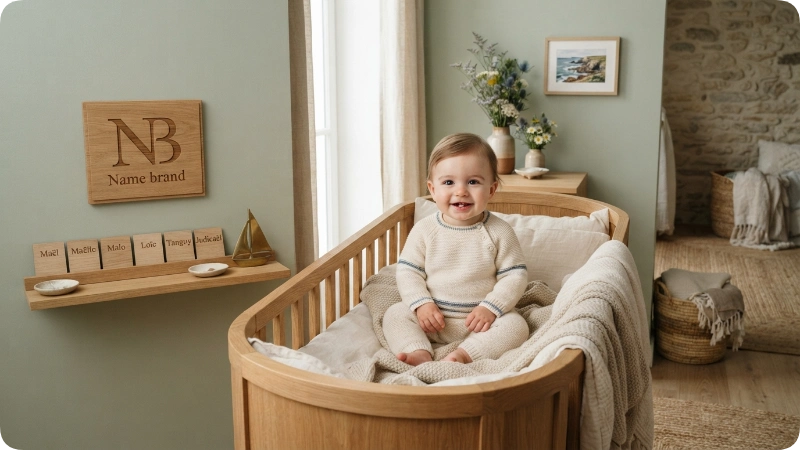
French naming also includes names connected directly with words, plants, places, or abstract concepts.
Rose
Rose is both a French word and a given name. It refers directly to the flower and ultimately connects with Latin rosa. It has a long history as a personal name in French and other European languages.
In 2025, Rose was the sixth most given girl name in France, showing that the name is not merely historical.
Fleur
Fleur means “flower” in French. Unlike a name such as Louise, its meaning is directly connected to the modern French vocabulary.
It is best understood as a French word name rather than a name whose entire etymology originated independently within French naming.
Victoire
Victoire means “victory” and corresponds to the French form of the Latin Victoria. It gives the name a particularly direct French lexical identity.
Céleste
Céleste comes from Latin caelestis, meaning “heavenly” or “of the sky/heaven.”
An important gender point is that Céleste is not exclusively feminine in French. It can be used for both children, so families should not assume that an English language naming list’s gender classification automatically applies to French usage.
Iris
Iris comes from Greek and is associated with the rainbow; it is also the name of the flowering plant. It is used in France but is not exclusively French in origin.
That makes Iris another good example of a name that can fit a French naming shortlist without being etymologically French.
Popular French Baby Names in 2025
Current popularity is useful when you want a name that is genuinely being chosen by families in France rather than merely appearing on international French name lists.
The latest official Insee figures cover births in 2025. The top ten were:
| Rank | Girls | Boys |
|---|---|---|
| 1 | Louise 3,070 | Gabriel 4,625 |
| 2 | Jade 2,925 | Noah 3,465 |
| 3 | Ambre 2,805 | Léo 3,420 |
| 4 | Alma 2,500 | Raphaël 3,285 |
| 5 | Alba 2,360 | Louis 3,260 |
| 6 | Rose 2,320 | Jules 3,040 |
| 7 | Emma 2,310 | Arthur 2,875 |
| 8 | Romy 2,245 | Léon 2,835 |
| 9 | Adèle 2,225 | Adam 2,810 |
| 10 | Alice 2,130 | Maël 2,700 |
Insee notes that the published counts are rounded to the nearest five. Its first name dataset covers births in France from 1900 through 2025 and provides national, regional, and departmental data.
There is also meaningful regional variation. In 2025, Gabriel was the leading boy name in 12 of France’s 18 regions, while girl name leaders varied more widely. In Brittany, for example, Malo led the boys’ ranking, while Louise and Adèle shared the top position among girls.
This is why “popular French name” should ideally mean popular among births in France in a specified year, rather than a vague claim about French speaking people worldwide.
French Baby Names by the Kind of Heritage They Carry
If you already know what kind of connection you want, the following shortlists make the larger list easier to navigate.
For classic French heritage
- Louise
- Louis
- Jeanne
- Jules
- Adèle
- Margot
- Claire
- Antoine
- Étienne
- Léon
For French names with Christian or biblical connections
- Gabriel
- Raphaël
- Adam
- Noah
- Madeleine
- Jeanne
- Baptiste
- Étienne
- Benoît
- Marie
These names differ in religious status. Some are directly biblical, some are associated with Christian figures, and others became traditional through Christian naming without being scriptural names themselves.
For Breton French heritage
- Maël
- Maëlle
- Malo
- Loïc
- Tanguy
- Judicaël
- Corentin
- Maïwenn
- Mahé
- Gaël
These should be understood as Breton or Breton linked names used in France, rather than simply calling every one “French origin.”
For short French names
- Lou
- Léo
- Léon
- Jules
- Rose
- Alice
- Emma
- Paul
- Marc
- Claire
Lou deserves a special note because it is used for both children in French and can function as a short form of Louise or Louis.
What Makes a Name “French”?
There are several different answers to that question.
A name may be French because of its form. Louis and Louise are clear examples.
It may be French because of long standing cultural use. Jeanne and Geneviève have strong historical associations with France.
It may be French because it is a French word used as a name. Fleur and Victoire fit this category.
It may be regional rather than broadly French. Maël, Maëlle, Malo, and Loïc connect French naming with Breton heritage.
Or it may simply be widely used in France despite having an older foreign origin. Gabriel, Adam, Noah, Arthur, Emma, and Sophie illustrate this broader category.
This distinction is more useful than trying to find a single “French origin” for every name. French naming has developed through centuries of contact among languages, religions, regions, royal traditions, literature, and modern naming preferences.
How to Choose a French Baby Name

If you want a name that feels distinctly French, first decide if you care most about French form, French history, current use in France, or regional heritage.
For a traditional French identity, Louise, Louis, Jeanne, Jules, Adèle, Margot, Claire, Antoine, and Étienne are strong starting points.
For a name currently used widely in France, the latest Insee data provides a more reliable guide than generic “popular French names” lists. Louise and Gabriel led the national rankings for children in 2025.
If regional heritage matters, look beyond Paris centered naming and consider Breton forms such as Maël, Maëlle, Malo, Loïc, or Tanguy.
If religion matters, check the actual religious history of the name. Gabriel, Raphaël, Adam, Noah, Madeleine, and Baptiste all have identifiable religious connections, but they are not therefore French in origin.
Pronunciation should also be part of the decision. Names such as Louis, Jules, Léon, Raphaël, Maël, Adèle, and Céleste can sound noticeably different when pronounced according to French conventions rather than English ones.
FAQs
What is the most popular French girl name?
For babies born in France in 2025, Louise was the most frequently given girl name, with 3,070 births according to Insee.
What is the most popular French boy name?
Gabriel ranked first among boys born in France in 2025, with 4,625 births.
Are French names always French in origin?
No. French naming includes names from Germanic, Latin, Greek, Hebrew, Breton, and other linguistic traditions. A name can be strongly French in form or usage while having an older non French origin.
What are some classic French girl names?
Louise, Jeanne, Adèle, Margot, Claire, Madeleine, Lucie, Juliette, Mathilde, and Geneviève are established traditional choices.
What are some classic French boy names?
Louis, Jules, Antoine, Étienne, Léon, Victor, Benoît, Clément, Rémi, and Gaspard have long standing French usage.
What are some French names with biblical connections?
Examples include Gabriel, Raphaël, Adam, Noah, Madeleine, Jeanne, and Baptiste. Their religious connections come from biblical or Christian history, while their French forms and usage developed separately.
Are Breton names considered French names?
Breton and French are distinct linguistic traditions, but many Breton names are used in France and some have established French forms. Maël, Maëlle, Malo, Loïc, and Tanguy are examples.
Is Maël a French name or a Breton name?
Both descriptions can be accurate depending on what is being discussed. Maël is a Breton origin name with established French usage. Its underlying Breton element means “prince, chieftain, lord.”
Is Louise originally a French name?
Louise is the French feminine form of Louis, so its form and usage are French, but its deeper linguistic roots belong to the Germanic name tradition behind Louis/Ludwig.
Final Thoughts
French baby names are best understood as a layered naming tradition, not as one closed list of names invented in France. French forms of older European names sit alongside biblical names, Christian traditions, French word names, literary choices, and regional traditions such as Breton naming.
For a classic choice, Louise, Louis, Jeanne, Jules, Adèle, Margot, Claire, or Antoine offer strong French cultural associations. For biblical or Christian heritage, Gabriel, Raphaël, Adam, Noah, Madeleine, and Baptiste provide more specific religious connections.

Brian Cox is a names editor and naming researcher at NameBrande.com who believes choosing a name starts with understanding its meaning, sound, and character. He focuses on boy names, naming styles, origins, and practical name ideas, turning research into clear, useful guides.
Areas of Focus: Boy Names | Name Meanings | Name Origins | Naming Styles | Name Ideas | Naming Research