
Arabic baby girl names come from more than one naming tradition. Some are ordinary Arabic vocabulary words, some are inherited from pre Islamic and classical Arab naming traditions, and others became especially important through Islam and the history of Muslim families.
That distinction matters. Arabic does not automatically mean Islamic, and Islamic does not automatically mean Arabic in origin. Arabic is the language and cultural context for many names, while Islam has its own religious figures, scripture, and naming traditions.
Behind the Name likewise notes that Arabic names are used throughout the Arab world and beyond it, and that not every name used in Arabic is necessarily Arabic in origin.
The names below therefore separate Arabic language names, Islamically significant names, and Arabic words that became personal names rather than putting them into one undifferentiated list.
Arabic Girl Names With Strong Islamic History
Several Arabic feminine names are closely connected with important women in early Islamic history. Their religious significance comes from the people who bore them, not necessarily from the names being Quranic words.
| Name | Meaning | Origin / Language | Cultural or Religious Context |
|---|---|---|---|
| Aisha / A’isha / Ayesha | Living, alive | Arabic | Name of Aisha bint Abi Bakr, a wife of Prophet Muhammad. The name is derived from an Arabic root associated with living. |
| Fatima / Fatimah / Fatema | Derived from an Arabic root meaning “to abstain” or “to wean” | Arabic | Name of Fatima, daughter of Prophet Muhammad and wife of Ali. The religious association is historical rather than Quranic. |
| Khadija / Khadijah | Premature child | Arabic | Name of Khadija, the first wife of Prophet Muhammad and an important figure in early Islamic history. |
| Ruqayya / Ruqayyah | Rise, ascent | Arabic | Name of one of Prophet Muhammad’s daughters. The name is derived from an Arabic root associated with rising or ascending. |
| Zaynab / Zainab | Meaning uncertain | Arabic usage | A historically important Muslim name borne by a daughter, granddaughter, and two wives of Prophet Muhammad. Its exact etymology is disputed. |
| Amna / Aamina / Aaminah | Safety, security | Arabic | An Arabic name derived from the root associated with being safe. It is also the name traditionally associated with the mother of Prophet Muhammad. |
These names are often called “Islamic girl names,” but that label describes their religious and historical use, not necessarily their linguistic origin. Aisha, Fatima, Khadija, Ruqayya, Zaynab, and Amna are Arabic names with strong Islamic historical associations.
Quranic Names and Arabic Words Used as Girl Names
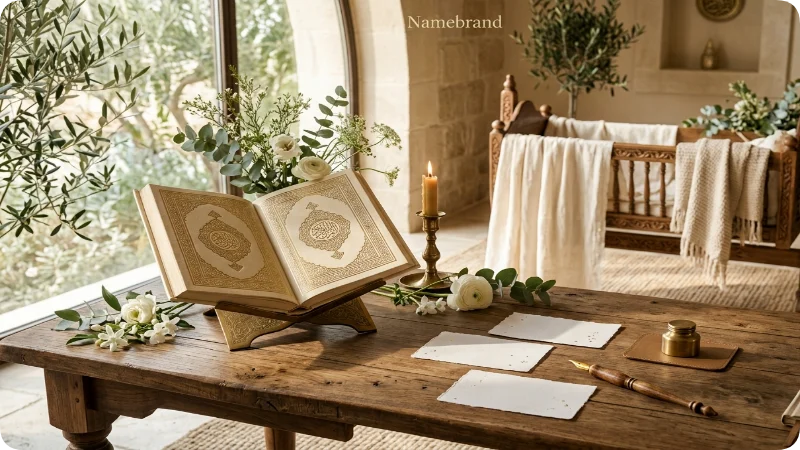
A different group consists of Arabic words that appear in the Quran and are also used as personal names.
Maryam
Meaning: Arabic form of Miryam; traditional meaning is not securely established
Origin: Hebrew/Biblical name represented in Arabic as مريم
Religious connection: Explicitly Quranic and the name of the mother of Isa (Jesus)
Maryam deserves special treatment because calling it simply an “Arabic origin name” would be misleading. Behind the Name describes Maryam as the Arabic form of Miryam appearing in the Quran.
The Quran directly names Maryam in Surah Maryam 19:16 and recounts her story through the birth of Isa. The Quranic Arabic Corpus also identifies the passage as the story of Mary in chapter 19.
So Maryam is best described as a non Arabic origin name with an established Arabic form and an explicit Quranic connection.
Aya / Ayah
Meaning: Sign, evidence; verse
Origin: Arabic
Religious connection: Quranic vocabulary
Aya (آية), also written Ayah, is an Arabic word meaning a sign or evidence. It also refers to a verse of the Quran. Behind the Name specifically records both senses.
This makes Aya different from a name such as Fatima: its Quranic connection comes from the Arabic word itself, rather than from a historical person.
Huda
Meaning: Right guidance
Origin: Arabic
Religious connection: Quranic concept
Huda comes from the Arabic root related to guiding someone along the right way. The Quran uses huda repeatedly for guidance; for example, the Quranic Arabic Corpus identifies hudan as “guidance” in 2:2.
Noor / Nur
Meaning: Light
Origin: Arabic
Gender: Feminine and masculine in some naming traditions
Religious connection: Strong Islamic association
Noor, Nur, Nour, Noura, and related spellings should not automatically be counted as separate names. They represent transliteration and regional spelling differences around نور. Behind the Name lists Noor/Nur as feminine and masculine and gives the Arabic meaning “light.”
The religious association is especially strong because al Nur occurs in the Quran, including the famous imagery of divine light in 24:35.
Rahma
Meaning: Mercy, compassion
Origin: Arabic
Religious connection: Quranic/religious concept rather than a personal figure
Rahma comes from the Arabic word for mercy and compassion. Behind the Name gives the meaning “mercy, compassion.” The Quran also repeatedly uses the concept of rahmah; Quran 30:21, for example, speaks of affection and mercy between spouses.
Traditional Arabic Names Based on Everyday Meanings
Not every Arabic baby girl name needs a religious story behind it. Arabic naming traditions also draw heavily from ordinary vocabulary, nature, qualities, objects, and social concepts. This is one reason a large Arabic name list can contain both religiously significant and completely non scriptural choices.
| Name | Meaning | Origin / Language | Context |
|---|---|---|---|
| Amal | Hope, aspiration | Arabic | A vocabulary name; feminine and masculine usage exists in Arabic. |
| Basma | Smile | Arabic | Directly derived from an Arabic root meaning “to smile.” |
| Arwa | Female ibex, mountain goat | Arabic | Traditional Arabic name; also borne by relatives of Prophet Muhammad and a medieval queen of Yemen. |
| Ghada | Graceful woman | Arabic | Traditional Arabic feminine vocabulary name. |
| Lina | Soft, tender | Arabic | Arabic vocabulary name; can also be connected with an Arabic word for a type of palm tree. |
| Lujayn | Silver | Arabic | Arabic vocabulary name referring to silver. |
| Malika | Queen | Arabic | Feminine form related to Malik; a direct Arabic title/name meaning queen. |
| Layla / Laila | Night | Arabic | Classical Arabic literary name associated with the famous Layla and Majnun tradition. |
| Yasmin / Yasmeen / Yasmine | Jasmine | Arabic usage; ultimately Persian | Arabic uses the name for the jasmine flower, but its deeper lexical origin is Persian yāsamīn. |
The distinction around Yasmin is worth preserving. It is widely used in Arabic, but the word itself entered Arabic from Persian. That makes it an excellent example of why usage and etymological origin are not always identical.
Short Arabic Baby Girl Names

Parents looking for a shorter name can narrow the list by length without losing cultural authenticity.
Some useful choices include:
- Aya: Sign, evidence; also a Quranic verse.
- Amal: Hope, aspiration; used for beings in Arabic.
- Huda: Right guidance.
- Lina: Soft, tender.
- Noor / Nur: light; usage can be feminine or masculine depending on naming tradition.
- Arwa: Female ibex, mountain goat.
- Amna Safety.
These are not all religious names. That is precisely the point: short Arabic names can come from religious vocabulary, ordinary Arabic words, or established personal name traditions.
Arabic, Islamic, and Quranic Are Not the Same Category
One of the most useful distinctions when researching Arabic baby girl names is to separate three labels:
| Label | What it tells you | Example |
|---|---|---|
| Arabic | The name is used in Arabic and/or comes from Arabic vocabulary. | Basma, Amal, Ghada |
| Islamic | The name has a meaningful connection to Islamic history, tradition, or religious usage. | Aisha, Fatima, Khadija |
| Quranic | The word or personal name actually occurs in the Quran. | Maryam, Aya, Huda related vocabulary, Noor related vocabulary |
These categories can overlap, but they are not interchangeable.
For example, Fatima is Arabic and strongly Islamic through the historical figure Fatima, but it is not a Quranic personal name. Aya is an Arabic word and Quranic term, but its significance does not come from being the name of a particular woman in Islamic history. Maryam is explicitly Quranic, but its underlying name is not originally Arabic; it is the Arabic form of an older name.
This classification is especially important because many current Arabic name websites combine “Arabic,” “Islamic,” and “Quranic” into one list.
Arabic Girl Names Across Different Arab Regions
“Arabic” is a language and cultural category rather than the name of a single country.
Arabic speaking communities extend across North Africa, the Levant, the Arabian Peninsula, Iraq, and other regions, and spelling and pronunciation can vary considerably.
For example:
- Khadija / Khadijah has forms such as Khadiga in Egyptian Arabic and Khadidja in Maghrebi usage.
- Khadidja is particularly associated with Maghrebi Arabic spelling conventions.
- Aisha has forms including A’isha, Aishah, Ayesha, Aysha, and Aïcha, with regional differences in transliteration and pronunciation.
- Maryam also appears as Mariam and Mariem in Arabic usage, including Maghrebi forms.
- Layla, Laila, Leila, and Leyla can represent related forms across Arabic, Persian, Turkish, Kurdish, and other languages.
For official documents, it is sensible to choose one Roman spelling and use it consistently rather than treating every transliteration as a different name.
How to Choose an Arabic Girl Name
A useful shortlist can be built around the kind of connection you want, rather than simply searching for the longest list.
If religious history matters
Consider names such as:
Aisha, Fatima, Khadija, Ruqayya, Zaynab, or Amna.
Their importance comes primarily from Islamic history and the women who carried these names.
If you specifically want a Quranic connection
Look more closely at:
Maryam, Aya, Huda, and Noor/Nur.
But verify what kind of Quranic connection each has. Maryam is a named person in the Quran, while Aya and Noor are Quranic vocabulary, and Huda is a Quranic concept of guidance.
If you want an Arabic cultural name without a specifically religious focus
Options include:
Basma, Amal, Ghada, Lina, Lujayn, Malika, Layla, and Arwa.
Their meanings come primarily from Arabic vocabulary or established Arabic naming traditions.
If spelling across countries matters
Look at the Arabic script before settling on the English spelling. Names such as Aisha, Khadija, Fatima, Maryam, Noor, and Layla have multiple established Romanizations.
The Arabic spelling is often more useful for identifying if two English spellings represent the same underlying name.
FAQs
Are Arabic baby girl names always Islamic?
No. Arabic is a language and cultural category, while Islam is a religion. Many Arabic names are ordinary vocabulary names with no specific religious association. Conversely, some names used by Muslims are not Arabic in origin.
Is Maryam an Arabic name?
Maryam is the Arabic form of Miryam and is explicitly used in the Quran. It therefore has established Arabic usage and a strong Quranic identity, but its underlying origin is older than Arabic.
Is Fatima a Quranic name?
Fatima is an Arabic name with major Islamic historical significance because of Fatima, daughter of Prophet Muhammad. It should not be described as a Quranic personal name simply because it is an important Muslim name.
Is Noor a girl’s name or a boy’s name?
Both. Noor/Nur is listed as feminine and masculine in Arabic and several other naming traditions. Usage depends on the country and cultural setting.
Is Amal only a girl’s name?
No. Behind the Name lists Amal as feminine and masculine in Arabic. It means “hope” or “aspiration.”
What is the difference between Arabic and Muslim girl names?
An Arabic girl name is connected primarily with the Arabic language or Arabic naming usage. A Muslim girl name is connected with Islamic religious or cultural usage. There is substantial overlap, but the two categories are not identical.
Final Thoughts
The most useful way to research Arabic baby girl names is to look beyond a name’s sound and ask where it actually comes from. Some names are directly Arabic in language and meaning, while others are Arabic forms of older names, names connected to important Islamic figures, or Arabic words that became personal names.
A careful shortlist might therefore include Aisha, Fatima, Khadija, and Ruqayya for Islamic historical connections; Maryam, Aya, Huda, and Noor for Quranic or religious vocabulary connections; and Amal, Basma, Lina, Layla, Lujayn, Malika, and Arwa for established Arabic language naming traditions.
The strongest choice depends on if your priority is language, cultural heritage, religious history, Quranic connection, meaning, or regional spelling.

Brian Cox is a names editor and naming researcher at NameBrande.com who believes choosing a name starts with understanding its meaning, sound, and character. He focuses on boy names, naming styles, origins, and practical name ideas, turning research into clear, useful guides.
Areas of Focus: Boy Names | Name Meanings | Name Origins | Naming Styles | Name Ideas | Naming Research